Postwar
by Tony Judt

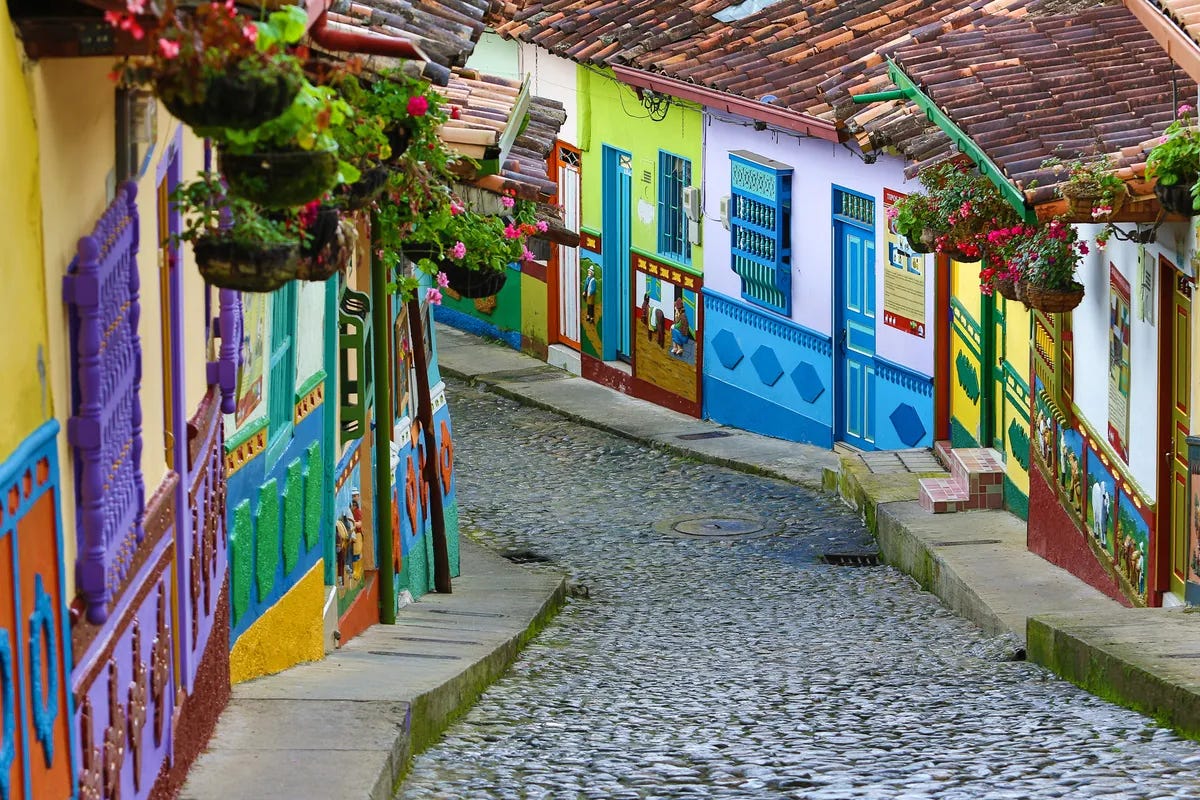
My son went to preschool in a strip mall next to a McDonald’s. Whoever designed the school’s interior tried to make you forget that. The interior walls of the school have a photo mural of the colorful houses of Guatapé, Colombia. It is a Spanish-immersion school, and the feeling of immersion begins with this mural, which makes you feel like you’re walking on Guatapé’s steeply graded cobblestone street.
All of the teachers and staff know all of the children and greet them by name when they walk in the door. That school was the first place I ever left my child in the care of others. He went there from age three until he started Kindergarten, and he was back as recently as July, when he participated in the school’s summer session.
In November, ICE agents chased a teacher from the parking lot into the building and violently seized her during school hours, in view of the children she cared for. Video shows two agents slamming her face-first into the school’s glass door. Eyewitnesses claim that armed agents pushed people who tried to intervene and that they entered the school again after arresting the teacher and demanded paperwork from other people on the premises.
For three days after the raid, the school was closed and everyone stayed home. The teacher, Diana Santillana Galeano, was held in a detention center in Indiana. Her lawyer asserts that she has the correct documentation to work legally in the U.S. She was released after a week by a judge who ruled that her detention without a bond hearing was unlawful.
*
The next book in my human migration series is Postwar by Tony Judt.
Postwar is a history of Europe after 1945. Judt is trying to show the context for Europe’s change from the destruction of two world wars to the stability that followed. He covers many things in his long book, but one of them is the mass movement of people after the end of World War II.
Judt’s first chapter is called “The Legacy of War,” and he begins by surveying the devastated state Europe was in after six or so (depending on the country) years. “World War Two was primarily a civilian experience,” he says. “Formal military combat was confined to the beginning and end of the conflict. In between, this was a war of occupation, of repression, of exploitation and extermination, in which soldiers, storm-troopers and policemen disposed of the daily lives and very existence of tens of millions of imprisoned peoples. In some countries the occupation lasted most of the war; everywhere it brought fear and deprivation.” He cites how many dwellings were destroyed by 1945, how many villages and towns, factories, and miles of rail track. How many people had died; how many were homeless; how many were prisoners of war. The way the population of women dramatically outweighed the population of men, so many of whom had died in combat; the number of orphaned children. How many women and others had been raped. How many calories a day people were eating. The incidence of tuberculosis, of typhoid.
The problem of feeding, housing, clothing and caring for Europe’s battered civilians (and the millions of imprisoned soldiers of the former Axis powers) was complicated and magnified by the unique scale of the refugee crisis. This was something new in the European experience. All wars dislocate the lives of non-combatants: by destroying their land and their homes, by disrupting communications, by enlisting and killing husbands, fathers, sons. But in World War Two it was state policies rather than armed conflict that did the worst damage.
Stalin had continued his pre-war practice of transferring whole peoples across the Soviet empire. Well over a million people were deported east from Soviet-occupied Poland and the western Ukraine and Baltic lands between 1939-41. In the same years the Nazis too expelled 750,000 Polish peasants eastwards from western Poland, offering the vacated land to Volkdeutsche, ethnic Germans from occupied eastern Europe who were invited to ‘come home’ to the newly-expanded Reich. This offer attracted some 120,000 Baltic Germans, a further 136,000 from Soviet-occupied Poland, 200,000 from Romania and others besides–all of whom would in their turn be expelled a few years later. Hitler’s policy of racial transfers and genocide in Germany’s conquered eastern lands must thus be understood in direct relation to the Nazis’ project of returning to the Reich (and settling in the newly-cleared property of their victims) all the far-flung settlements of Germans dating back to medieval times. The Germans removed Slavs, exterminated Jews and imported slave workers from west and east alike.
Between them Stalin and Hitler uprooted, transplanted, expelled, deported and dispersed some 30 million people in the years 1939-43. With the retreat of the Axis armies, the process was reversed. Newly-resettled Germans joined millions of established German communities throughout eastern Europe in headlong flight from the Red Army. Those who made it safely into Germany were joined there by a pullulating throng of other displaced persons.
Judt can only touch on the many nuances of the response to such a large-scale crisis. He says there was a new distinction between displaced persons (such as the German diaspora returning to Germany from places they’d settled, assumed to have somewhere to go to) and refugees (who were considered homeless). Some people, especially Soviet citizens who feared reprisals from Soviet authorities, were forcibly returned. “There were terrible scenes of desperate struggle, particularly in the early post-war months, as Russian émigrés who had never been Soviet citizens, Ukrainian partisans and many others were rounded up by British or American troops and pushed–sometimes literally–across the border into the arms of the waiting NKVD. Once in Soviet hands they joined hundreds of thousands of other repatriated Soviet nationals, as well as Hungarians, Germans and other former enemies deported east by the Red Army. By 1953 a total of five and a half million Soviet nationals had been repatriated. One in five of them ended up shot or dispatched to the Gulag. Many more were sent directly into Siberian exile or else assigned to labour battalions.” After the start of the Cold War, authorities stopped forcibly repatriating people. Western Europe accepted some of these now stateless people to do manual work in coal mines, construction, and agriculture. Canada accepted women and girls as domestic workers but rejected applicants “if there was any sign that they had education beyond secondary school. And no-one wanted older people, orphans, or single women with children.”
Originally, the refugee camps were integrated, but Jewish residents ultimately had to be separated from their former persecutors. Jews were not welcome back in Eastern Europe or in the West. After the creation of the state of Israel, 332,000 European Jews left, many directly from refugee camps in Germany.
“Overall the US admitted 400,000 people in these years, with another 185,000 arriving in the course of the years 1953-57. Canada allowed in a total of 157,000 refugees and DPs, Australia took 182,000.”
Judt says that, after World War I, borders were invented and adjusted. After World War II, in response to a feeling that the Versailles Treaties had failed, borders stayed the same and people moved.
Before the wars, nations had been diverse, with people of different ethnicities, nationalities, and religions living together. Judt describes much of the postwar re-sorting as ethnic cleansing, before either the term or the disapproval around it existed. The outcome was a Europe of nation states more ethnically homogeneous than ever before. Judt argues that this homogeneity created a basis for stability, and that the project of economic integration that led to the European Union was not a hopeful, visionary project based on an optimistic vision of the future. It was a fearful reaction to the past.
Postwar came out in 2005, and Judt died of ALS a few years later. He was paralyzed from the neck down by the end of his life. He did not update the book to address the global financial crisis. He did not live to see Germany opening its doors to a million refugees. He missed Brexit, and the war in Ukraine. An Irish friend described her shock at turning on the TV and seeing a war happening in real time on the continent of Europe, epitomized by news footage of “bombs falling on the H&M.”
*
OK, what’s a light note to end on?
Maybe it would be false to try and end on a light note. So I’ll just promise that next week I’m going to write on a different topic, and get back to human migration the week after. I have more delightful poems to share, and a commentary on the dust-jacket biography of a prolific writer of mass-market thrillers.
In the meantime, I am going to take advantage of the last pulse of non-freezing weather around here to sow some milkweed seeds and install that rabbit-proof fence around my flower beds. See you next week.
I appreciated reading this.