Moderation
by Elaine Castillo

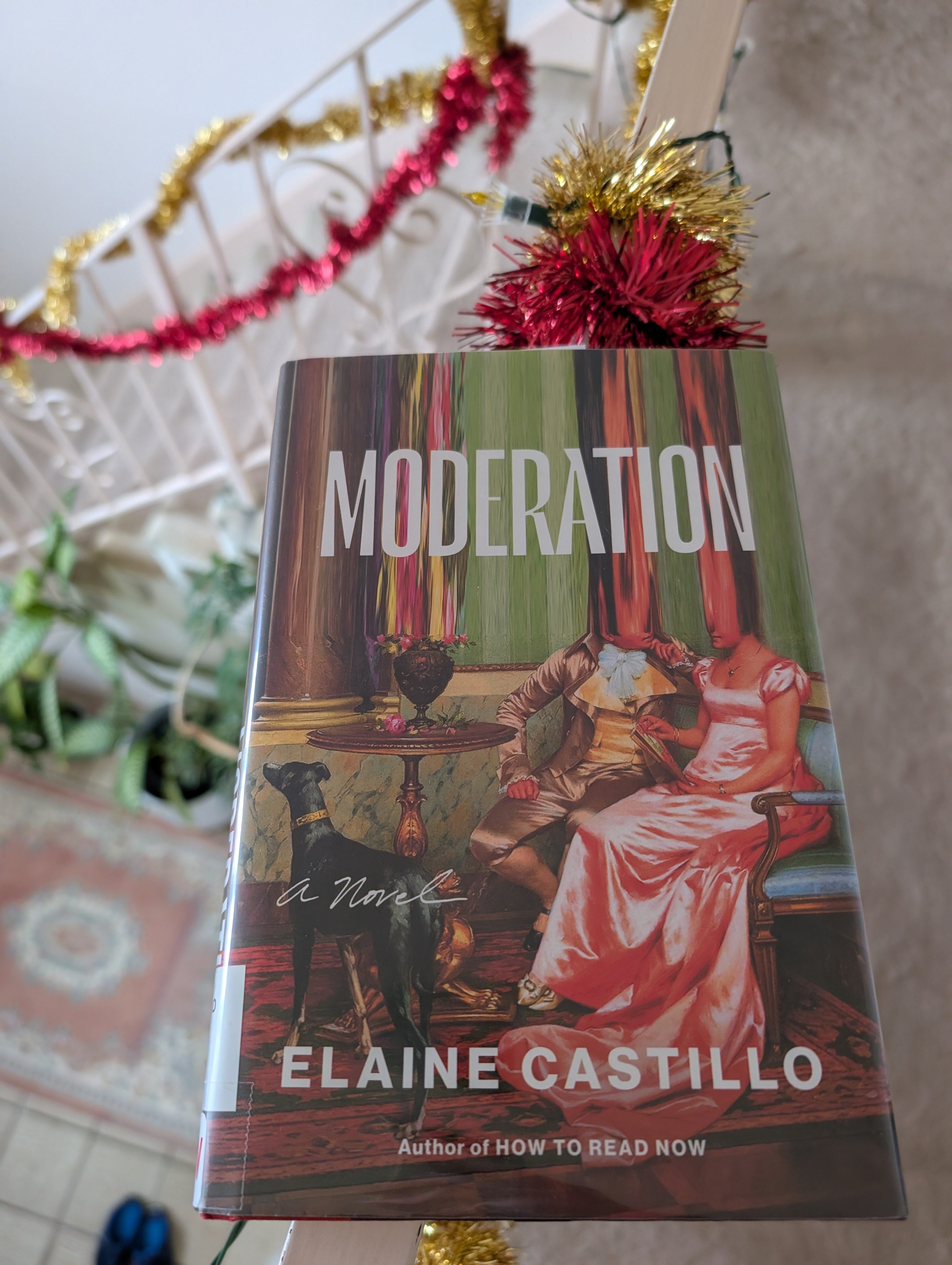
Warning: this book contains disturbing material that I briefly discuss in this post. The book’s protagonist is a content moderator specializing in child pornography.
Content moderators at the fictional social media company in Moderation review videos that have been flagged as possible violations of the company’s guidelines. It isn’t always easy to tell whether something is what it seems to be. For example: Does a video that looks like child pornography feature an actual child, or is it a young adult who is pretending to be a child? New hires are required to give presentations explaining their judgments. One presenter pauses mid-presentation to vomit in a trash can under the lectern.
Our protagonist, Girlie, has been doing this job for years. She has outlasted her peers, and shown very few outward signs of distress or self-destruction. She specializes in child pornography cases. The video in question is real—she can tell by the child’s socks.
Girlie, and many of her colleagues, are Filipina. In the Las Vegas office of a tech company, as in many other industries in many places around the world, they are the people in the lowest-level, most punishing jobs, doing the work that can’t be automated, acting as the human sacrifices that make global capitalism possible.
Girlie has survived in this job by cutting herself off emotionally from everyone, even within her closest relationships. Her family, which had been prosperous, suffered during the economic crash of 2008 and has not recovered, and Girlie has an overwhelming sense of filial responsibility. She financially supports her mother and her cousin. But while she lives for them, she cannot treat them lovingly.
Then she gets a promotion that changes the day-to-day nature of her job. The company is developing a new virtual reality product, where users can wear VR gear and interact with each other in an immersive, three-dimensional virtual space, and it’s her job to go in among them and keep an eye on their interactions. Virtual assaults are shown, and the possibility that users will organize and create hateful spaces in this new reality is hinted at but not really explored. The book basically touches on Girlie’s new job but isn’t that interested in it. Mostly, the book turns its attention to how Girlie meets a nice guy and finds a good therapist, and how these people help her begin to take off some of her psychological armor.
So while the book began in a hair-raising fashion, I felt it almost immediately abandoned its premise and became a totally different book. I asked myself whether I really wanted the book to stay as brutal as it was at the beginning, and why. And it certainly was nicer to read about falling in love and taking swimming lessons than about, you know. But I hadn’t signed up for a romance novel. I had signed up for what seemed like it was going to be a confrontational, incisive book about modern labor.
When I wrote about Esther Yi’s novel Y/N, I said that the joy of reading the book was its ongoing, dogged commitment to its insane premise. This book was the opposite of that. It’s gotten some attention. It’s on the longlist for the Women’s Prize, and Castillo just received a Whiting Award. There is an excerpt from the book on the Whiting website, and I notice it’s from the beginning of the book, when it seems like it’s going to be something other than what it is. Are people responding to what the book might have been, rather than what it is? Why is that good enough?
My publisher, Miami University Press, has added a donations page to their website.
Their annual novella prize is the contest that discovered and published Garth Greenwell’s debut, Mitko, which became the first section of What Belongs to You.
If you like to write novellas, if you think you might ever enter the contest, which turns 20 this year, this is a transformative opportunity.
Consider buying a book, or making a donation. Because if they are asking, that’s a hint that they need your support. If you let me know, I’ll make a donation to match whatever you donate or spend.
Starting a new week with a new writer always feels like opening a different version of the world.
This time, it was Roddy Doyle. And I haven’t stopped thinking about Paddy Clarke Ha Ha Ha since finishing it.
I wrote a reflection on it here: https://freshoffmyshelf.substack.com/p/paddy-clarke-hahaha-is-this-what?r=7t861m&utm_medium=ios
For readers who enjoy books examined from quieter, deeper angles.
Yeah, as hard as the tough content would be to read, that kinda seemed like the point? It's a shame the book didn't follow through on its promise!