Guided autobiography
is fun to do

One of my college instructors said that when men write autobiography, they tend to write about significant events that happened only to them - professional achievements, etc. You might read the autobiography of a prominent man and never know that he had a family. Whereas when women write about themselves, their own stories are inextricable from the stories of their spouses and children, their parents and siblings, their neighbors and friends.
Is this true? It sounds like just one of those things people say, maybe especially at the women’s college I attended. Yet I think about it often. It was on my mind recently when I led a guided autobiography workshop at a senior center. Guided autobiography is a method developed by a gerontologist named James Birren that is meant to help people who may not normally think of themselves as writers to write down their own life stories.
I asked this group of (entirely women) to write about “branching points” where their lives could have gone one way but instead went another. Several of them wrote about decisions their fathers made. These women were in their 80s, and these things struck them as so significant that it’s what they chose to talk about out of so many decades of experiences. I asked them, “Was your father someone who reflected on things, who talked with you about what happened to him or what might have been?” They responded firmly, “Not at all.”
I liked the way that, by remembering and writing about their own lives, they were remembering and writing about the lives of their fathers, too. They didn’t necessarily know many details about their fathers’ lives and weren’t writing records of those lives, exactly, but rather doing the reflection that the fathers did not do themselves.
This reminds me of this passage from Marguerite Duras’s book The Lover, which I talked about before.
The better-off natives used to go to the photographer’s too, just once in their lives, when they saw death was near. Their photos were large, all the same size, hung in handsome gilt frames near the altars to their ancestors . . . the portraits themselves were invariably touched up in such a way that any facial peculiarities, if there were any left, were minimized. All the faces were prepared in the same way to confront eternity, all toned down, all uniformly rejuvenated. This was what people wanted. This general resemblance, this tact, would characterize the memory of their passage through the family.
I’m so struck by this idea of a life as a passage through a family.
I can’t take a picture of my copy of Birren’s book, Telling the Stories of Life through Guided Autobiography Groups, which I used for reference in planning and conducting the workshop, because I gave my copy to the staff person at the senior center. But if you are a writer who’s been asked to do a community engagement event, this is way less stressful than trying to get people to come to one of your readings.
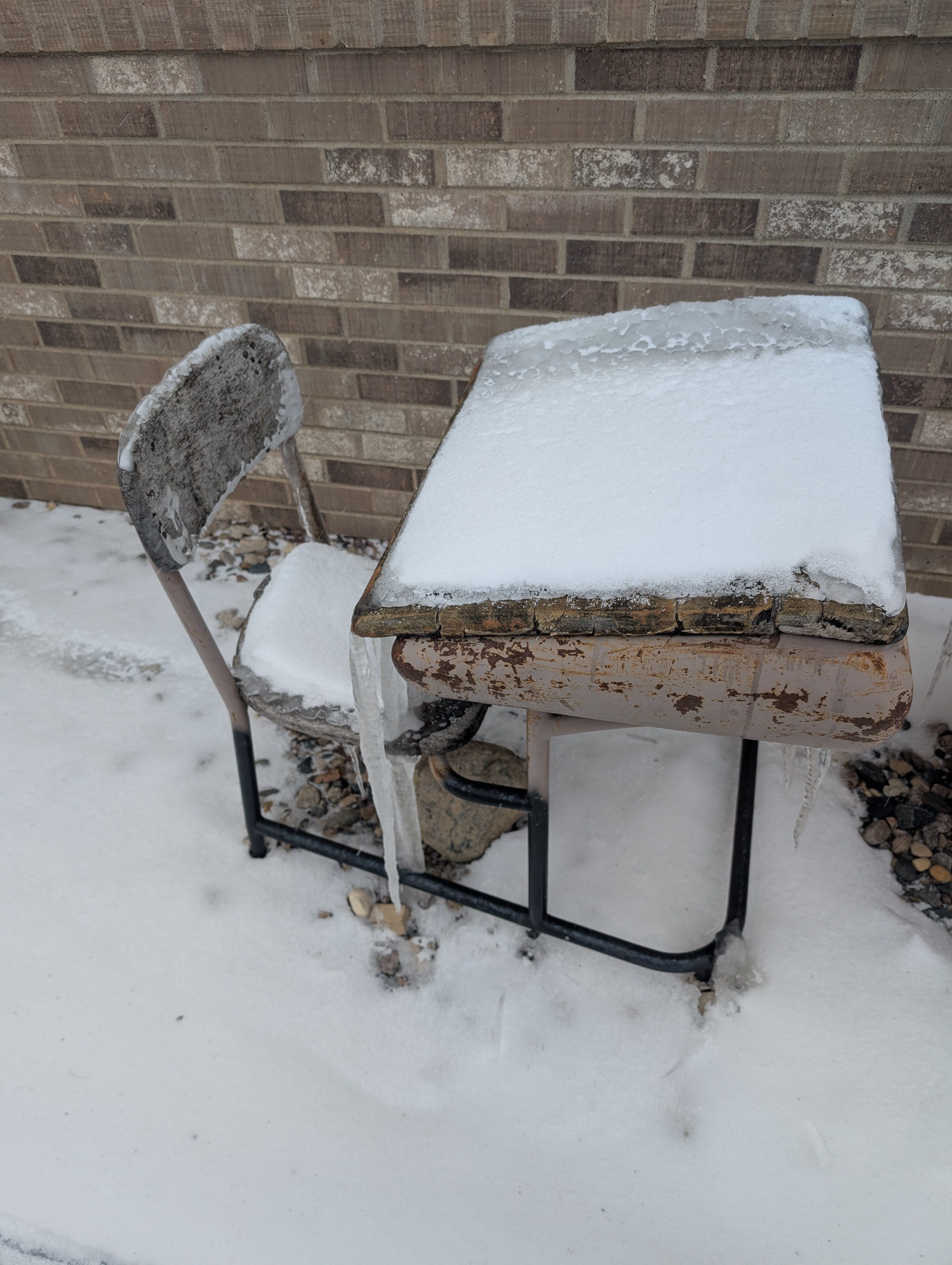
Since I can’t share a photo of the book, here is an actual desk I saw while on my recent residency. This pretty much sums up how it sometimes feels to sit at your desk and try to write. Happy spring!
(On the theme of women’s writing, men’s writing, and talking about your family, I guess I will weigh in on the Ben Lerner discourse by sharing my profound irritation with the following quotation from the Vulture profile. Discuss amongst yourselves.)
Lerner’s friend, the poet and scholar Jeff Dolven, points out that, in Transcription, he has managed to turn “the great spoiler of the avant-garde, the family,” into an avenue for experimentation: “He’s done this very strange thing, which is to make his absolute embeddedness in, and commitment to, and fear for, and love of his family into art.”
This is a statement that deserved to be dismissed, rather than highlighted. And here I am highlighting it further.
Insightful. Thanks for sharing this.
Kudos to you on your reaction to that final comment by 'the poet and scholar' (Ohh, dear POET AND SCHOLAR!!!) Jeff Dolven,
"this very strange thing, which is to make his absolute embeddedness in, and commitment to, and fear for, and love of his family into art.” Okay...
So, One Hundred Years of Solitude by Gabriel García Márquez?
So much of Dickens
Ann Patchett?
To the Lighthouse?
Austen? Salinger with Franny and Zooey, Raise High, etc?
TOLSTOY????
That sound you hear is my mind boggling. Thanks for the provocation